
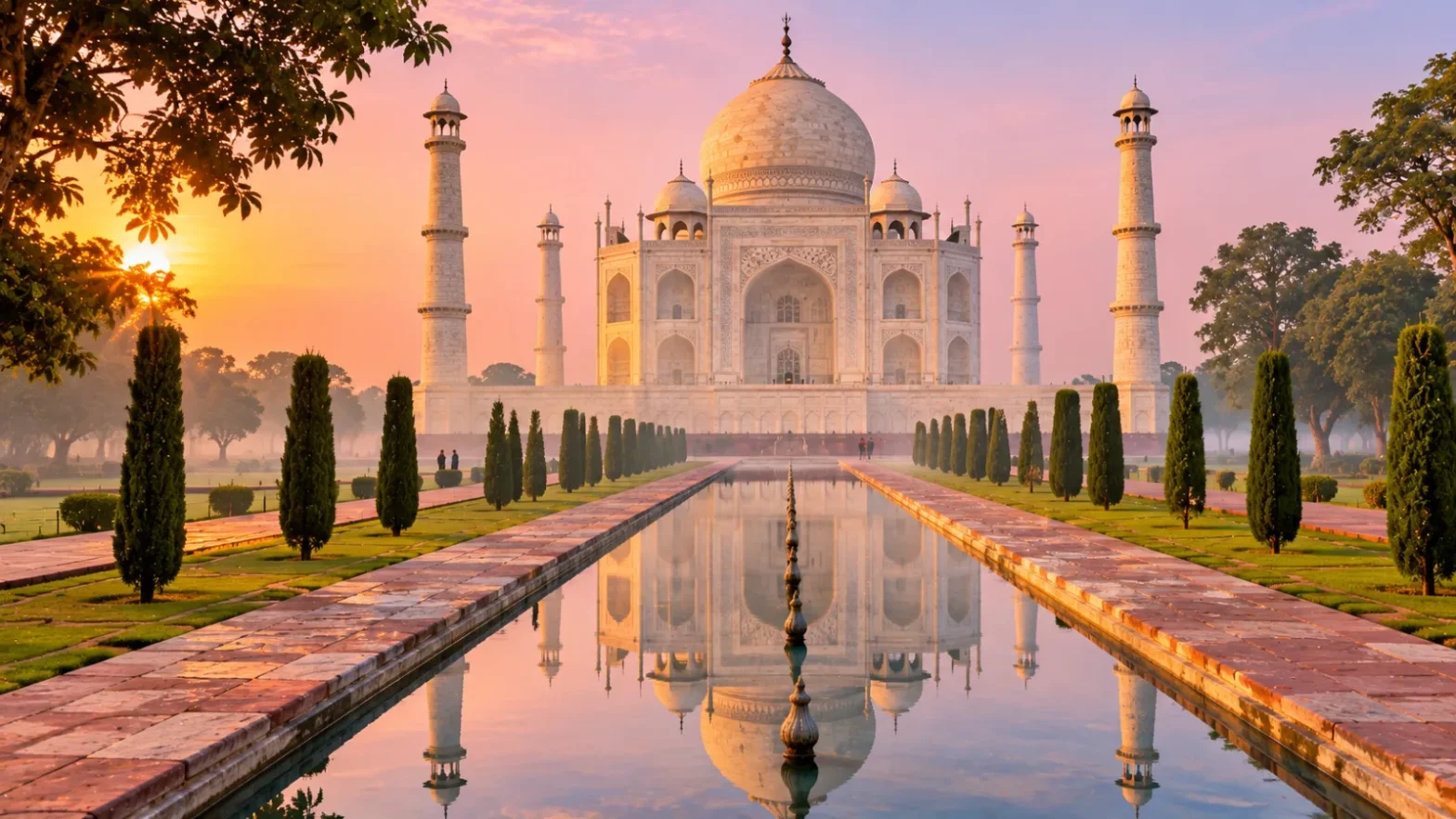
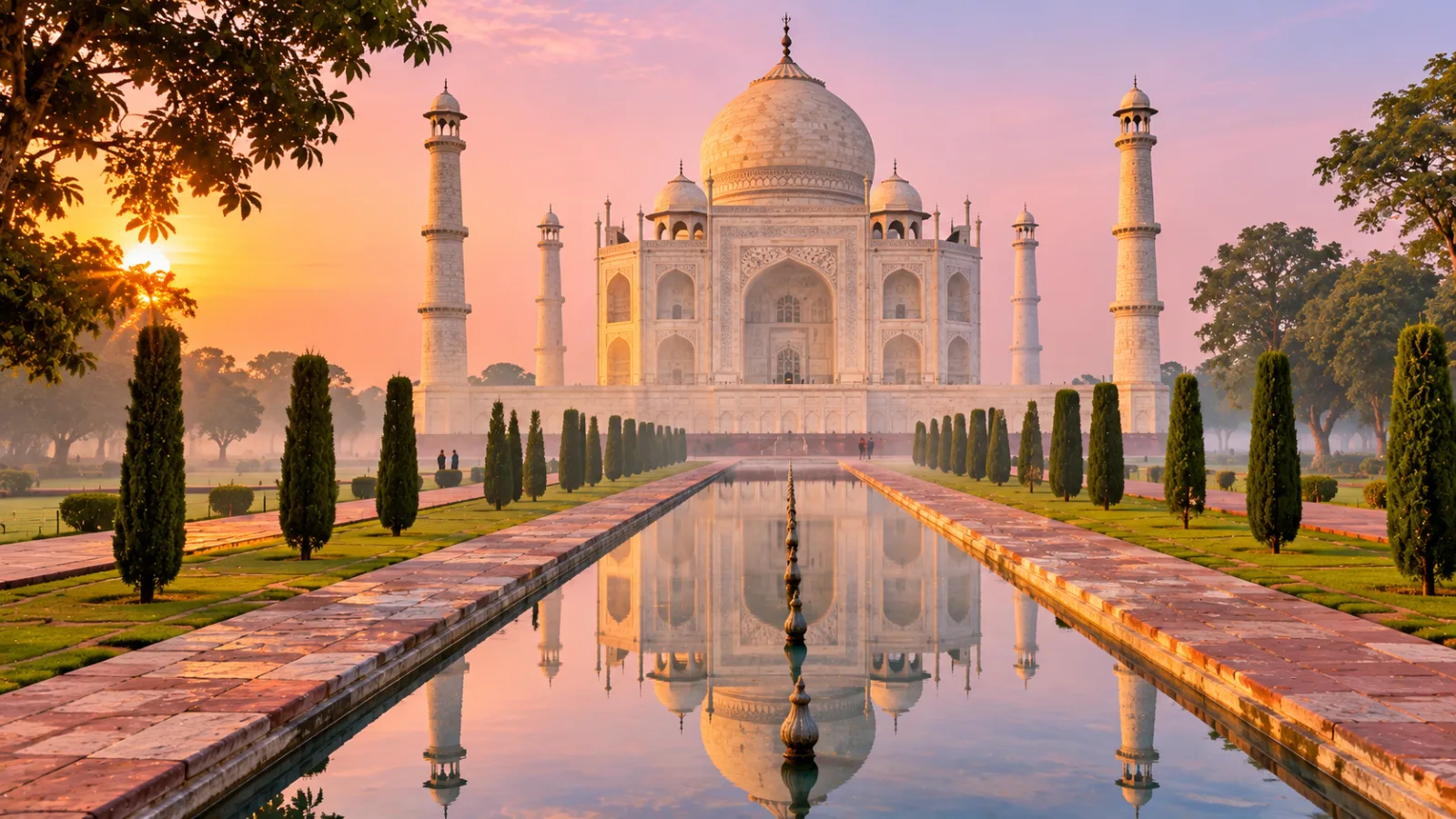
The best way to visit the Taj Mahal is at sunrise on any day except Friday: a foreigner’s ticket costs ₹1,100 plus ₹200 for the mausoleum (about €13), and if you’re at the East Gate by half past six you’ll see the marble turn pink without the big crowds.
One building, one morning, and you’ll understand why the whole world talks about it.
The Taj Mahal is India’s most famous building, and rightly so. No photo prepares you for the moment you walk through the great gate and suddenly see the white mausoleum at the end of the long pool. But a visit can also disappoint: long queues, heat, pushy sellers and a locked gate because it happens to be Friday.
We have been driving travellers to Agra since 2010, often several times a month. This guide has everything you need to do it right. You’ll find the official ticket prices and opening times, which gate to choose, when the light is best and what you can and can’t bring. You’ll also find the best photo spots, the full moon nights, what else to see in Agra and how to get there from Delhi.
“Is the Taj Mahal really as beautiful as everyone says, or is it mostly crowded?” – a question we get almost every week
Short answer
Yes, it really is that beautiful, especially if you plan it well. Go at sunrise, on any day except Friday (when the Taj is closed). Buy your ticket online: for foreigners it costs ₹1,100, plus ₹200 if you want to enter the mausoleum, about €13 together. Children under 15 enter free. Bring only a small bag, with no food, tripod or charger. Allow 2 to 3 hours for the Taj itself and a full day for Agra, with Agra Fort, the Baby Taj and sunset at Mehtab Bagh. Prices and rules may change; check the official website just before your visit.
On this page
- The Taj Mahal at a glance
- Opening times 2026 and 2027
- Tickets and prices 2026
- How to buy your ticket online
- Which gate: East, West or South?
- Sunrise or sunset: when is it most beautiful?
- What can you bring, and what not?
- Your visit, step by step
- What you see inside the walls
- The best photo spots
- The Taj Mahal by full moon
- Free entry during the Urs
- What else to see in Agra
- Agra in 1 or 2 days: two plans
- How to get from Delhi to Agra
- The best months for the Taj Mahal
- Avoiding scams and annoyances
- Visiting the Taj Mahal with our drivers
1. The Taj Mahal at a glance
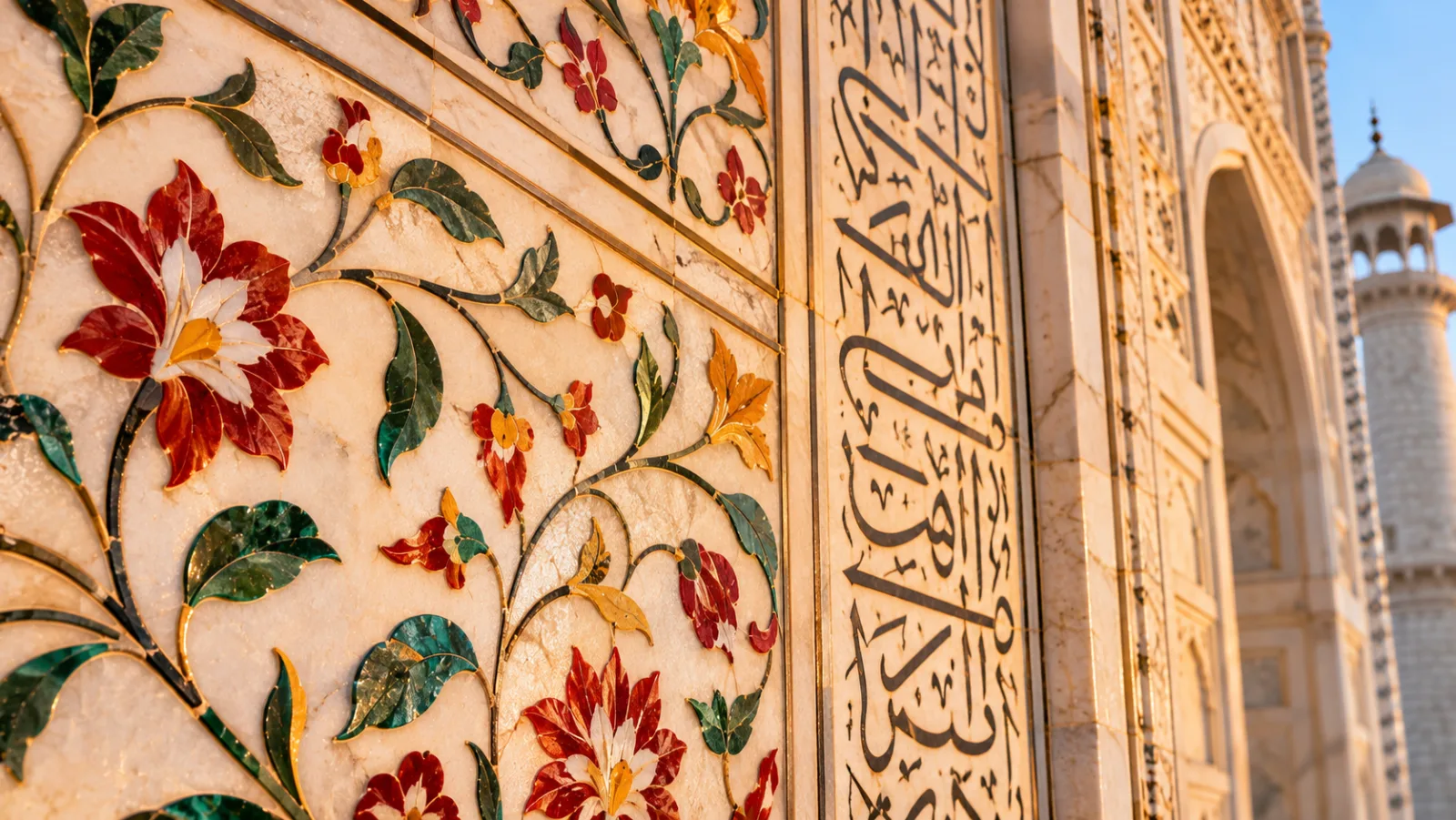
The Taj Mahal is a white marble mausoleum on the bank of the Yamuna in Agra. Mughal emperor Shah Jahan built it for his beloved wife Mumtaz Mahal, who died in 1631 giving birth to their fourteenth child. Work on the building and gardens took more than twenty years.
| Fact | What to know |
|---|---|
| Where | Agra, Uttar Pradesh, about 230 km from Delhi |
| Built | approx. 1632 – 1653, by Shah Jahan |
| For whom | Mumtaz Mahal, his wife |
| Material | White marble from Makrana (Rajasthan), inlaid with semi-precious stones |
| World Heritage | On the UNESCO list since 1983 |
| Closed | Every Friday |
| Time needed | 2 to 3 hours for the complex |
Did you know? The four minarets lean very slightly outwards. That way, in an earthquake they would fall away from the mausoleum, not onto it.
2. Opening times 2026 and 2027
The Taj Mahal opens half an hour before sunrise and closes half an hour before sunset, so the exact time shifts with the seasons. The ticket offices at the East and West Gates are open from one hour before sunrise until 45 minutes before sunset.
| Period | Opening (approx.) | Closing (approx.) | Last entry (approx.) |
|---|---|---|---|
| October – March | 5:45 – 6:45 am | 5:00 – 6:10 pm | 45 minutes before closing |
| April – September | 4:55 – 5:45 am | 5:35 – 6:45 pm | 45 minutes before closing |
| Friday | Closed | Closed | Only for Friday prayers |
Closed on Fridays: on Fridays the Taj Mahal is closed to visitors. Only local Muslims may enter for the midday prayer in the mosque. This is the most common mistake when planning a trip, so never put your day in Agra on a Friday. Source: official Taj Mahal website.
Babu’s tip: “I leave the hotel with my guests at quarter past six. Then we’re at the front when the gate opens, and we get the first photos without people.”
3. Tickets and prices 2026
Foreigners pay a higher price than Indians. The price includes a contribution to the Agra Development Authority, and you get free shoe covers. For the mausoleum itself, where the tombs are, you pay ₹200 extra.
| Visitor | Complex entry | Mausoleum (optional) | Total | Approx. in euros |
|---|---|---|---|---|
| Foreigner | ₹1,100 | ₹200 | ₹1,300 | €13 |
| SAARC and BIMSTEC (incl. Nepal) | ₹540 | ₹200 | ₹740 | €7.50 |
| Indian or OCI cardholder | ₹50 | ₹200 | ₹250 | €2.50 |
| Child under 15 | Free | Free | Free | – |
- Cheaper online: foreigners get ₹50 off per ticket when they buy online.
- One entry: your ticket is valid for a single entry. If you leave, you need a new ticket.
- Maximum 3 hours: since 2018 there has been a maximum visit length of three hours.
- Bring your passport: foreigners must be able to show their passport at the entrance.
Prices according to the official ticket page (1 euro is roughly 100 rupees). Prices may change in the future.
4. How to buy your ticket online
An online ticket saves you the queue at the ticket office and ₹50. You buy it on the official ASI website asi.payumoney.com or on asiagracircle.in. Other websites are often resellers that charge extra.
- Choose the Taj Mahal and your date. Remember: not a Friday.
- Choose ‘Foreigner’ and the number of people. Tick the mausoleum if you want to go inside (we recommend it).
- Enter your name and passport number. These are checked at the entrance.
- Pay by credit card and save the QR code on your phone. A screenshot is enough.
- Have the QR code scanned at the foreigners’ entrance. You don’t need to go to the ticket office.
Tip: sometimes the payment page rejects a foreign credit card. Try again with another card, or buy your ticket at the ticket office on arrival. Your driver knows exactly where it is.
5. Which gate: East, West or South?
The complex has three gates. You enter through the East or West Gate; the South Gate is exit only. Cars can’t drive up to the Taj. Your driver drops you at a car park, from where you take an electric bus, a golf cart or walk to the gate.
| Gate | Parking | Crowds | Our advice |
|---|---|---|---|
| East Gate | Shilpgram | Quietest early in the morning | Best choice for sunrise |
| West Gate | Amrood ka Tila | Busy, especially from 10 am | Handy from the city centre and Agra Fort |
| South Gate | – | Exit only | Leads out into the Taj Ganj bazaar |
Babu’s tip: “At the East Gate the queue for foreigners is usually short. I drop you at Shilpgram and wait there. After your visit you call or message me, and I’m ready within ten minutes.”
6. Sunrise or sunset: when is it most beautiful?
The light changes the Taj Mahal every time. At sunrise the marble turns soft pink and gold, at midday it’s bright white, and at sunset warm orange. The time of day also decides how busy it is.
| Time | Light | Crowds | Our verdict |
|---|---|---|---|
| Opening to 8:30 am | Soft, pink and gold | Quiet | The most beautiful |
| 8:30 am – 12 noon | Clear | Getting busier | Good |
| 12 noon – 3:30 pm | Harsh, bright light | Very busy, hot | Better not |
| 3:30 pm to closing | Warm, golden light | Busy | Lovely alternative |
Watch out in December and January: mist often hangs over the river in the mornings. Sometimes you only see the Taj clearly at nine or ten o’clock. Stay two nights in Agra so you have a second chance.
Want to see the Taj at sunset without the crowds? Go to Mehtab Bagh, the garden across the river. From there you see the mausoleum from behind, with the Yamuna in front of it.

7. What can you bring, and what not?
Security at the Taj Mahal is strict, like at an airport. Anything not allowed has to go into a locker at the gate or back to the car. So bring as little as possible.
| Allowed | Not allowed |
|---|---|
| Small bag or bum bag | Large bags and backpacks |
| Phone (on silent) | Food, sweets and chewing gum |
| Camera | Tripod and drone |
| Bottle of water | Charger, power bank and headphones |
| Passport and ticket | Knives, lighters, cigarettes and tobacco |
| Sunglasses, hat, scarf | Books and large electronics |
- Photography: you can take photos anywhere outside. Photography is not allowed inside the mausoleum itself.
- Shoes: for the mausoleum you take off your shoes or put on the free shoe covers.
- Clothing: there is no strict dress code, but covered shoulders and knees are respectful and good against the sun.
Source: the visitor rules on the official website.
Tip: simply leave everything you don’t need in the car. Your driver stays with it and you get through security faster.
8. Your visit, step by step
This is what an ideal morning at the Taj Mahal looks like in winter. In summer everything is about half an hour earlier.
| Time | What you do |
|---|---|
| 6:15 am | Your driver picks you up at the hotel |
| 6:30 am | Park at Shilpgram, electric bus to the East Gate |
| 6:45 am | Security and ticket scan, through the great gate |
| 7:00 am | First view and photos at the pool |
| 7:30 am | Inside the mausoleum, with shoe covers |
| 8:00 am | The mosque, the guesthouse and the riverside |
| 8:45 am | Back to the car, breakfast at the hotel |
| 10:30 am | Agra Fort and then the Baby Taj |
A licensed guide tells you the stories behind the building. Drivers are not allowed to guide inside monuments. An official guide costs about €25 to €30, and your driver can help you find one. Only take a guide with an official ID card.
9. What you see inside the walls
The Taj Mahal is more than the white mausoleum. The whole complex was designed as a garden of paradise, with the tomb at its centre.
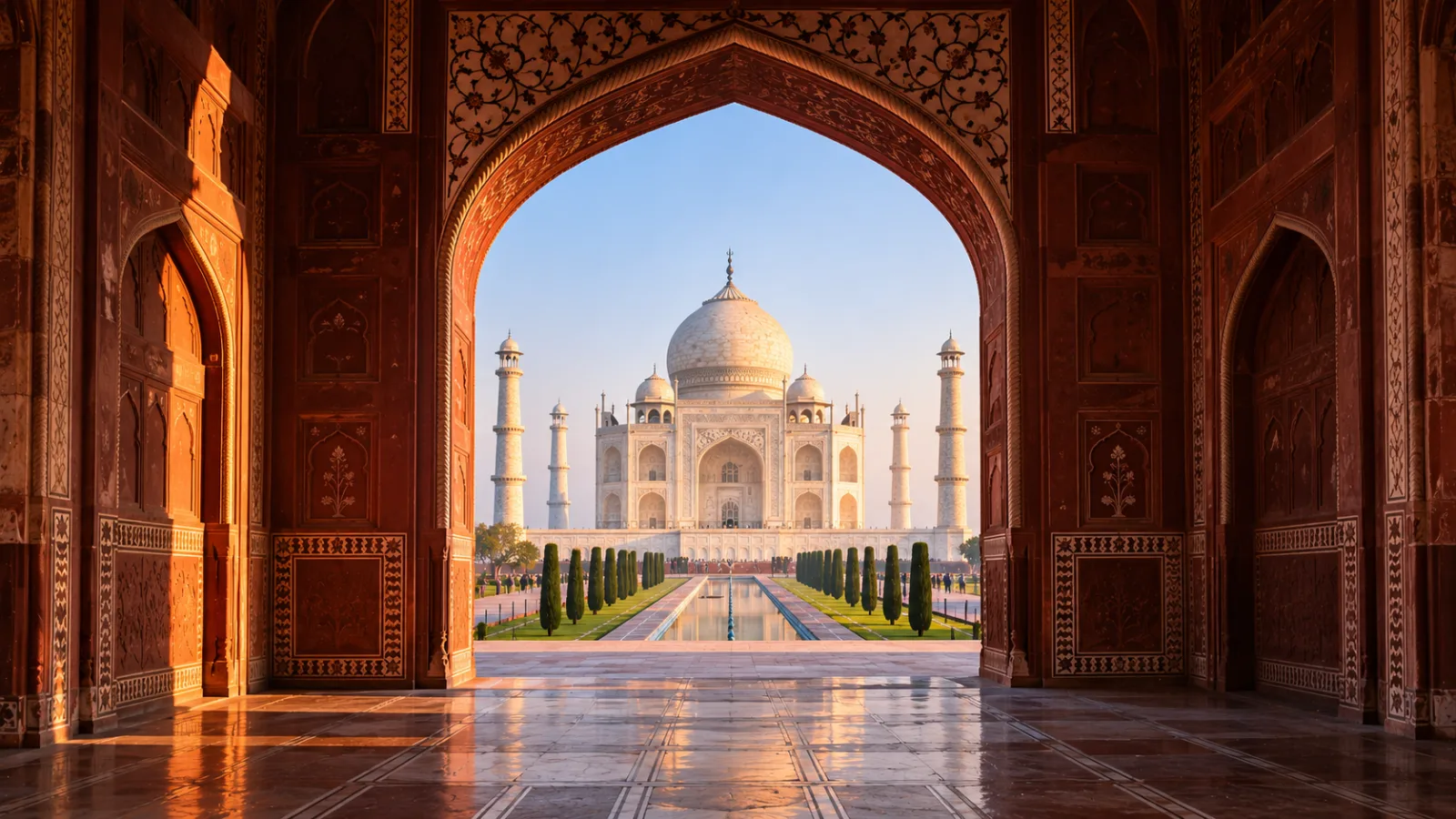
- The Great Gate (Darwaza-i-Rauza): the red sandstone gate you enter through. Only when you stand in the arch do you see the Taj all at once. That’s exactly the intention.
- The garden (charbagh): four sections with water channels, cypress trees and paths. The long pool in the middle gives the famous reflection.
- The mausoleum: inside are the marble tombs of Mumtaz Mahal and Shah Jahan, surrounded by a delicate marble screen. The real graves lie one floor below in a crypt.
- The mosque and the guesthouse: two red buildings on either side of the Taj. The mosque is still in use.
- The riverside: behind the mausoleum you look out over the Yamuna and see Agra Fort in the distance.
- The Taj Museum: free, in the western garden, with old drawings and objects. Open from 10 am to 5 pm.
10. The best photo spots
Everyone takes the same photo from the pool, and of course you shouldn’t miss it. But there are more places where the Taj looks its best.
- In the arch of the Great Gate: the Taj framed perfectly by the dark arch. Most beautiful just after opening.
- The bench by the pool: the famous bench halfway along the garden, with the reflection in the water. Go early; later there’s a queue.
- From the mosque: from the red arches on the west side you see the Taj between the sandstone.
- Along the side paths of the garden: between the trees, without people in the photo.
- Mehtab Bagh: the back of the Taj with the river in front, especially lovely at sunset.
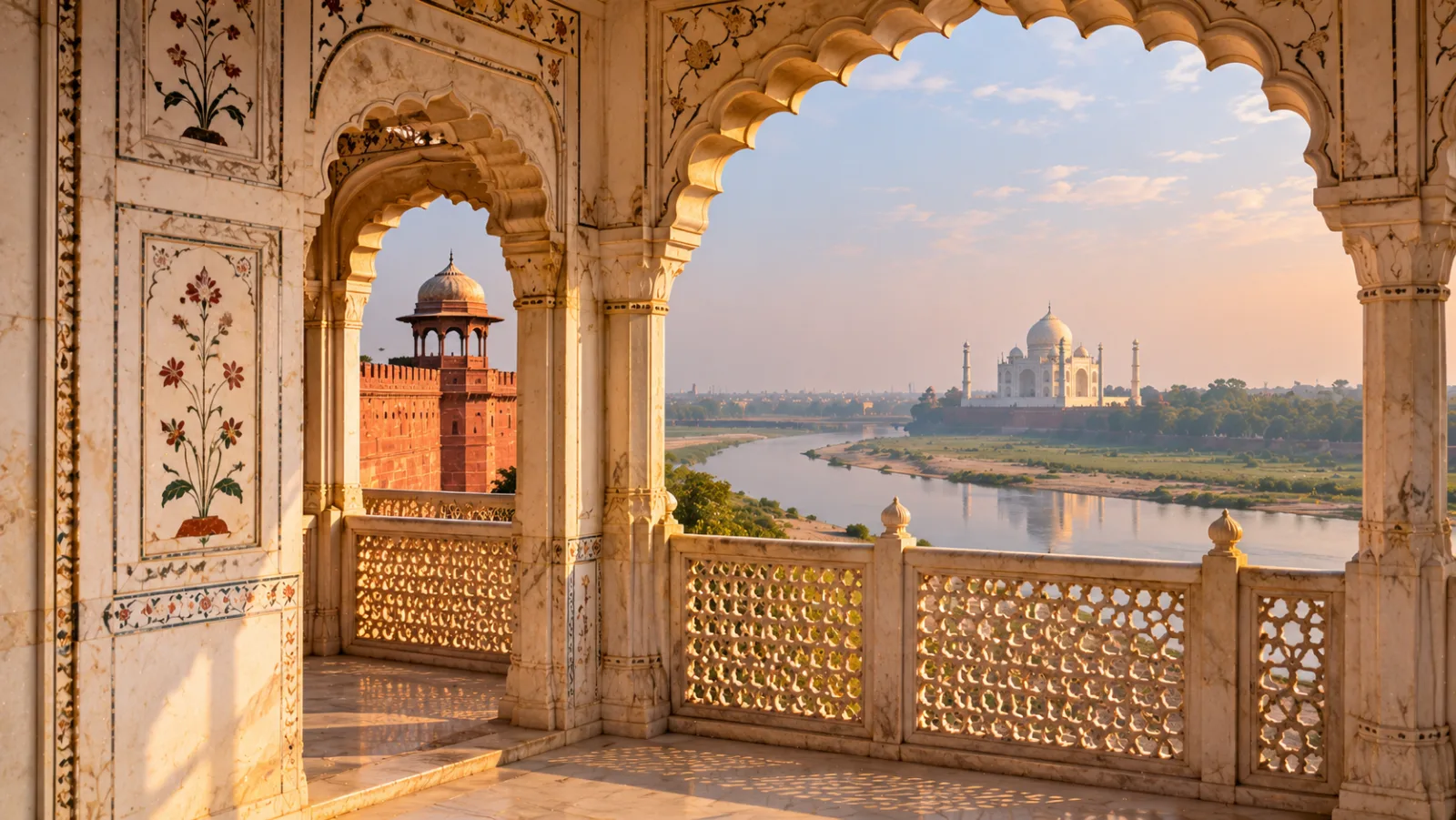
- Agra Fort: from the Musamman Burj you see the Taj in the distance, as Shah Jahan saw it in his last years.
- A rooftop in Taj Ganj: many cafés in the lanes by the South Gate have a rooftop with a view.
Tip: want a photo without people at the pool? Walk straight to the bench as soon as the gates open. After ten minutes the moment is gone.
11. The Taj Mahal by full moon
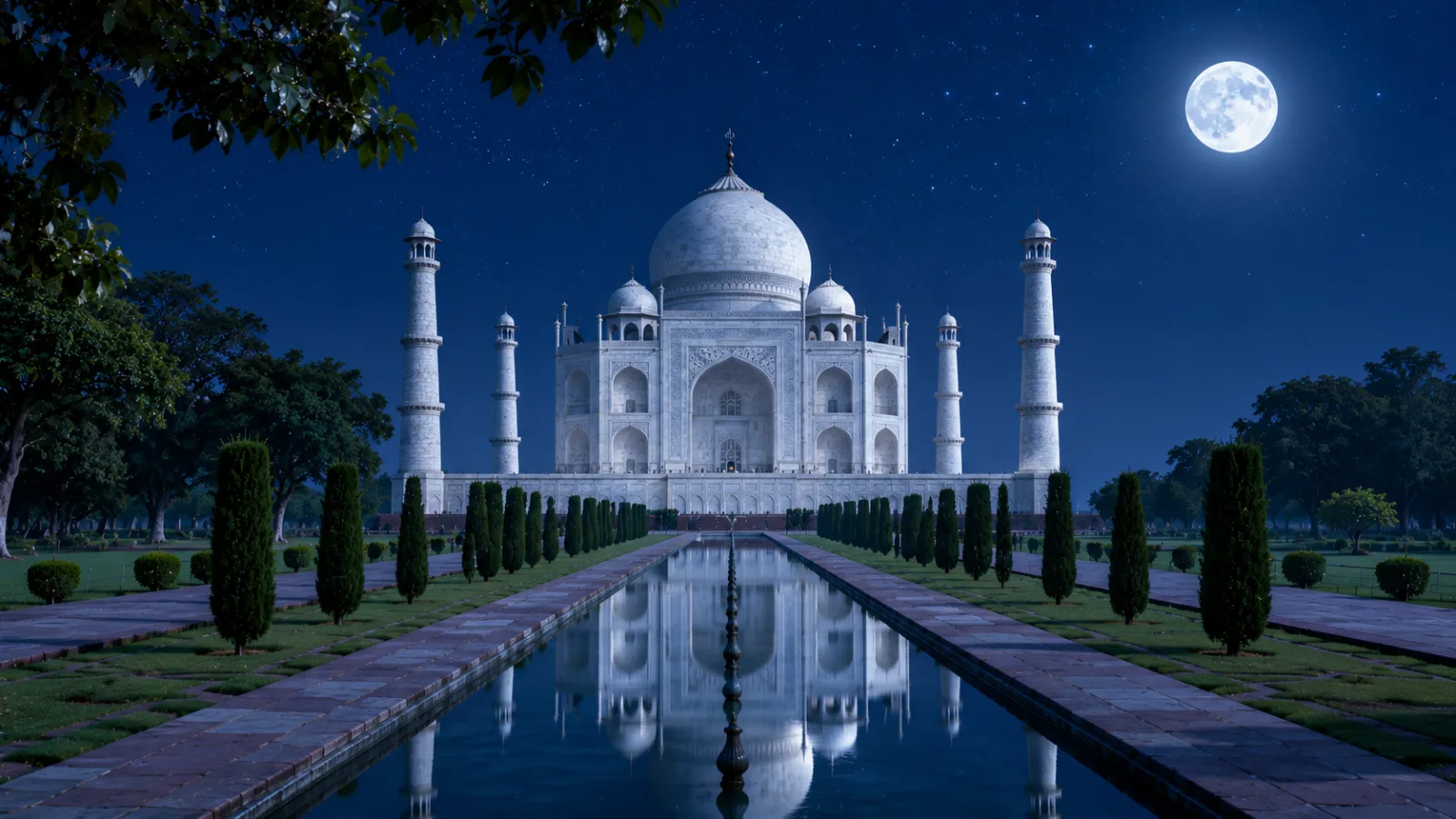
Five nights a month you can visit the Taj Mahal in the evening: the full moon night and the two nights before and after. The marble then glows silvery white in the moonlight. It’s a special experience, but it’s good to know how it works.
- Times: eight groups between 8 pm and midnight, each for 30 minutes.
- Group: a maximum of 50 people per group.
- Distance: you watch from a platform near the entrance, about 300 metres away. You don’t walk up to the mausoleum.
- Price: ₹750 for foreigners, ₹500 for children aged 3 to 15.
- Check-in: half an hour beforehand at Shilpgram, with your passport.
- Not allowed: phones and video cameras. Still cameras are allowed after the security check.
- Not on: Fridays and during Ramadan.
| Full moon (approx.) | Note |
|---|---|
| 24 November 2026 | High season |
| 23 December 2026 | Busy around Christmas |
| 22 January 2027 | Closed on the Friday itself, open the nights before and after |
| February 2027 | No night viewing due to Ramadan |
| 21 March 2027 | Open again after Ramadan |
Tickets are limited and sold through the official website. Check the exact nights and sales beforehand, as they can change. Source for the dates: Big Cats India.
Honest advice: from the platform the Taj looks fairly small, and the moonlight is sometimes weak because of haze. If your time is limited, choose sunrise. If you have an extra evening, the full moon is a lovely addition.
12. Free entry during the Urs
Once a year the anniversary of Shah Jahan’s death is commemorated with the Urs, a three-day religious festival. Entry to the Taj Mahal is then free at certain hours, and the real graves in the crypt, closed for the rest of the year, can be seen. A long colourful cloth (chadar) is carried to the graves.
In 2026 the Urs fell on 15 to 17 January. The date follows the Islamic calendar and moves about eleven days earlier each year. The dates for 2027 are usually only announced a few weeks in advance. Expect big crowds; it’s not the best moment for a quiet visit.
13. What else to see in Agra
Many travellers only see the Taj Mahal and drive on the same day. That’s a shame, because Agra has four more world-class monuments. If you’ve bought a Taj ticket that day, you pay a slightly lower price at the other ASI monuments.
| Monument | Foreigner price | After Taj visit | Time needed | Why go? |
|---|---|---|---|---|
| Agra Fort | ₹650 | ₹600 | 1.5 – 2 hours | Red sandstone and marble palaces, with a view of the Taj |
| Itimad-ud-Daulah (Baby Taj) | ₹310 | ₹300 | 45 minutes | Agra’s finest inlay work, and hardly any tourists |
| Mehtab Bagh | ₹300 | ₹300 | 45 minutes | The Taj at sunset from across the river |
| Fatehpur Sikri | ₹610 | ₹600 | 2 hours | Abandoned Mughal city, 40 km from Agra |
| Akbar’s Tomb, Sikandra | ₹310 | ₹300 | 1 hour | Peaceful tomb in a large park with deer and monkeys |
Prices according to the official ticket page; children under 15 free. Prices may change.
Agra Fort: this huge red sandstone fort was the centre of Mughal power for centuries. Shah Jahan spent his last years here, imprisoned by his own son. From the marble Musamman Burj tower he could see the Taj Mahal.
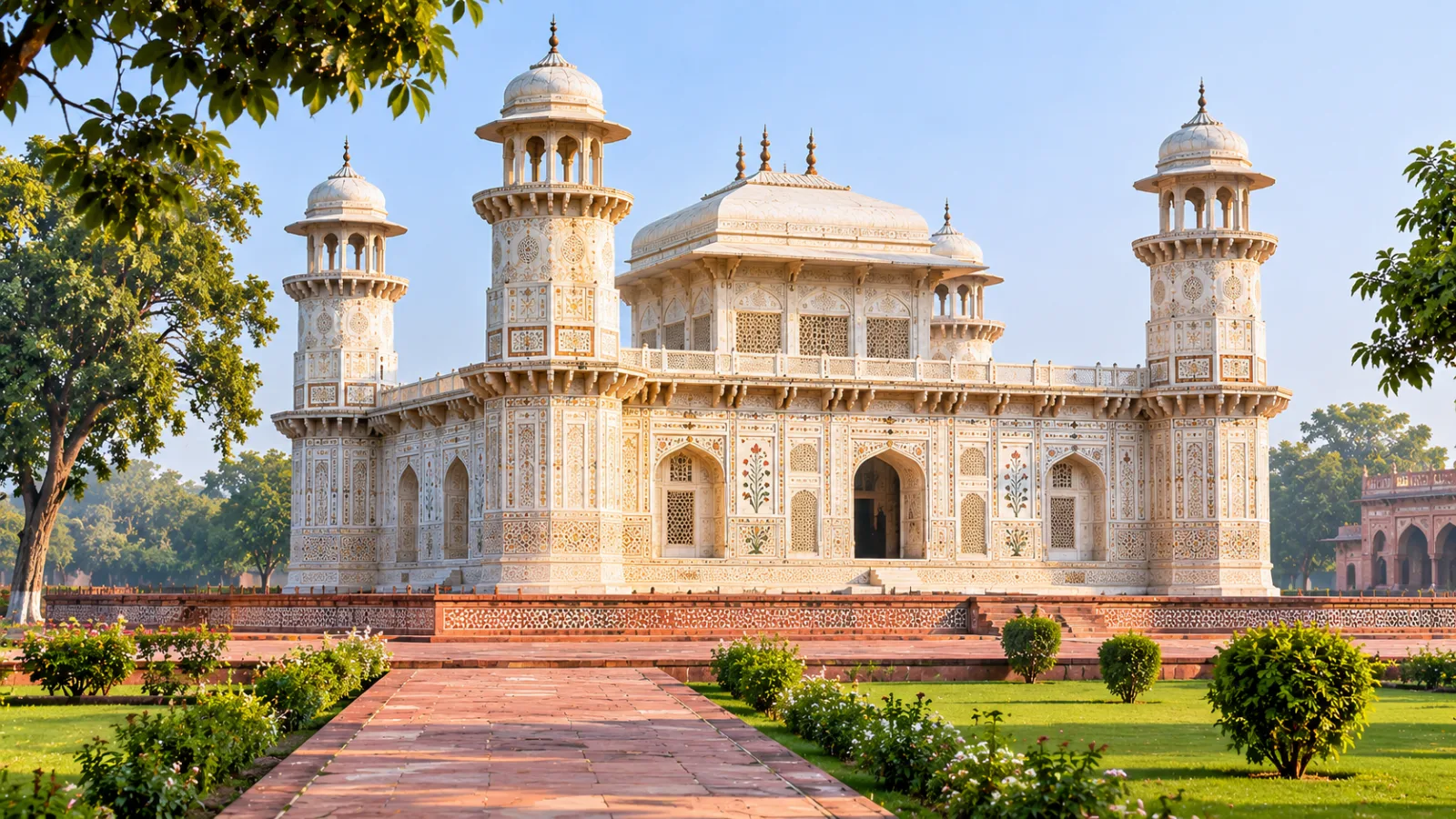
Itimad-ud-Daulah, the Baby Taj: this small, elegant tomb on the river was built before the Taj Mahal and is seen as a model for it. The semi-precious stone inlay here is perhaps even finer. Many travellers find it a surprising highlight.
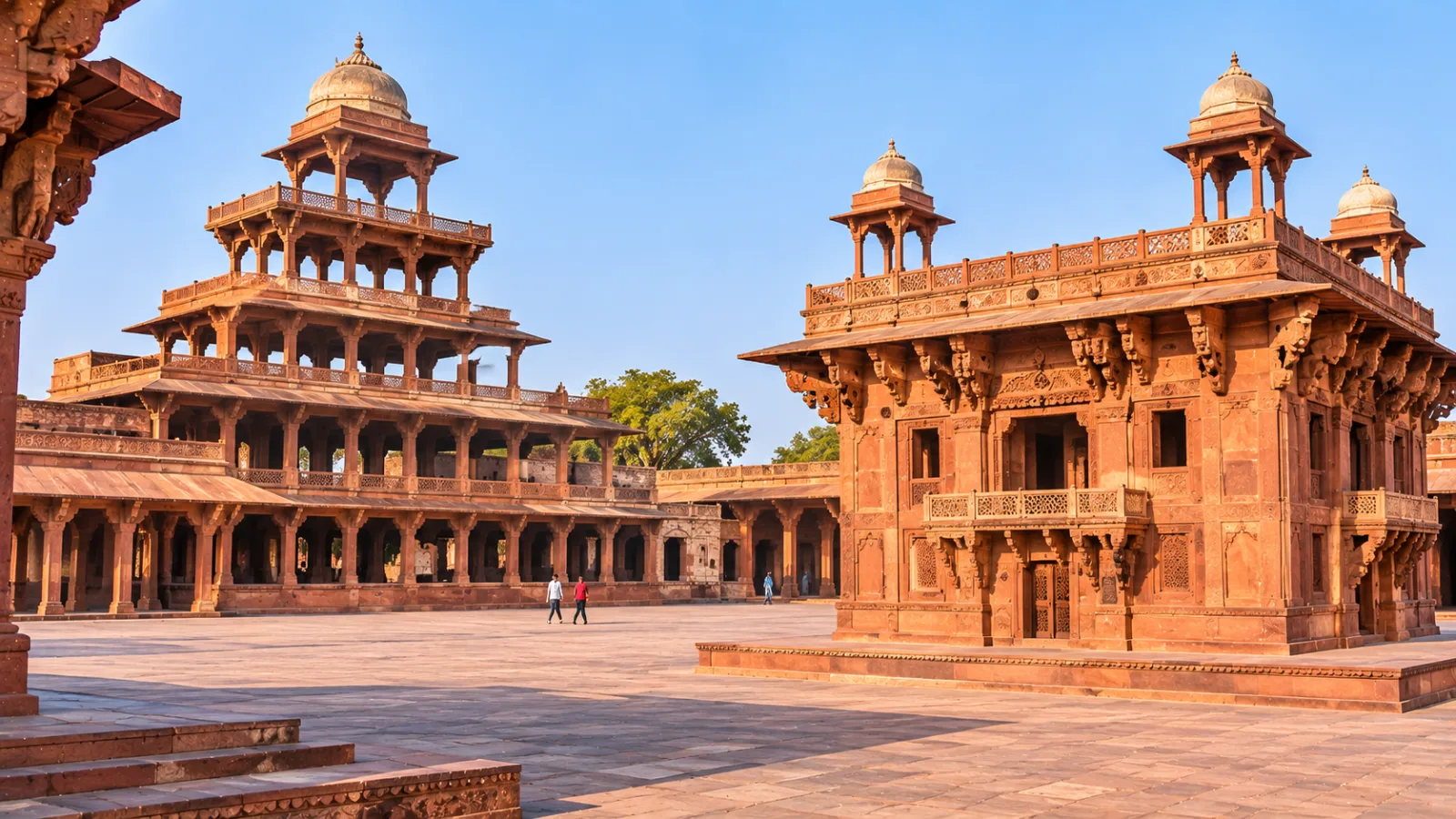
Fatehpur Sikri: Emperor Akbar built this red sandstone city as his new capital, but abandoned it after about fourteen years, partly because of water shortages. The palaces and the enormous Buland Darwaza gate are still almost intact. It’s easiest to visit on the way from Agra to Jaipur.
14. Agra in 1 or 2 days: two plans
How much time do you need in Agra? With one full day you see the highlights. With two nights you have time to relax, a second chance if it’s misty and time for Fatehpur Sikri.
| 1 day (2 nights in Agra) | 2 days (3 nights in Agra) | |
|---|---|---|
| Arrival day | From Delhi, Mehtab Bagh at sunset in the afternoon | From Delhi, take it easy, Mehtab Bagh |
| Morning | Taj Mahal at sunrise | Taj Mahal at sunrise |
| Afternoon | Agra Fort and Baby Taj | Agra Fort, Kinari Bazaar |
| Next day | On to Jaipur via Fatehpur Sikri | Baby Taj, Sikandra, maybe the full moon |
| After that | – | On to Jaipur via Fatehpur Sikri |
A day trip from Delhi is possible too, but then you spend seven to eight hours in the car in one day and miss sunrise. We recommend at least one night in Agra. Agra lies halfway along the classic Golden Triangle of Delhi, Agra and Jaipur, and is a fixed part of our tailor-made tours.
15. How to get from Delhi to Agra
Agra is about 230 kilometres south of Delhi. Since the Yamuna Expressway was built, the drive has become much faster and more comfortable.
| Transport | Travel time | Pros | Cons |
|---|---|---|---|
| Car with driver | 3.5 – 4 hours | Door to door, stop where you like, the driver stays in Agra | – |
| Train (Gatimaan or Vande Bharat Express) | approx. 2 hours | Fast | Fixed times, taxis to and from the station |
| Organised coach tour | 4 – 5 hours | Cheap | Fixed programme, often with compulsory shopping stops |
With your own driver you leave Delhi when you want, stop for breakfast or a photo on the way and are dropped at the gate in Agra. The same driver then takes you on to Fatehpur Sikri and Jaipur.
Babu’s tip: “Leave Delhi at seven in the morning, then you beat the city traffic. You’re in Agra around eleven and have the whole afternoon.”
16. The best months for the Taj Mahal
The best time to visit the Taj Mahal is from October to March, when it’s dry and not too hot. In summer Agra is often above 40 degrees, and during the monsoon it rains a lot.
| Period | Weather in Agra | Our advice |
|---|---|---|
| October – November | Dry, pleasant, clear | Very good |
| December – January | Cool, often morning fog | Good, plan 2 nights |
| February – March | Sunny and mild | Very good |
| April – June | Hot, often 40 °C or more | Only very early in the morning |
| July – September | Monsoon, green, fewer crowds | Possible, with rain |
For the weather month by month and region by region, with the festival dates for 2027, read our guide Best time to visit India 2027.
17. Avoiding scams and annoyances
A lot around the Taj Mahal revolves around tourists, and not everyone is honest. With these tips you’ll hardly be bothered.
- Fake guides: at the car park men offer themselves as ‘official guides’. Only take a guide with an official ID card.
- “The Taj is closed today”: sometimes people say the Taj is closed to lure you into a shop. It’s only really closed on Fridays.
- Overpriced tickets: only buy your ticket at the official ticket office or on the official website, not from middlemen in the street.
- Marble shops: Agra has many shops selling inlaid marble. Prices vary hugely. Your driver helps you bargain and knows where prices are fair.
- Photos with locals: Indian tourists often ask for a selfie with you. It’s usually well meant; you can always say no politely.
18. Visiting the Taj Mahal with our drivers
Since 2010, The Pearls of India has connected travellers directly with experienced, English-speaking drivers in Delhi, with no travel agency in between. Babu has been driving since 1996 and knows Agra like the back of his hand: the quietest gate, the best time to leave and where to have a good lunch.
| Car | People | Per day | Golden Triangle, 8 days |
|---|---|---|---|
| Suzuki D-zire | 1 – 3 | €59 | €472 |
| Toyota Innova Crysta | 3 – 5 | €75 | €600 |
| Tempo Traveller | 4 – 8 | €110 | €880 |
The driver, fuel, tolls, parking, taxes, insurance and an average of 200 km per day are included. Hotels, entry fees, guides and tips are not included. You pay the driver yourself: 50% on arrival in Delhi and 50% halfway through the trip. Please note: prices may change in the future. You always receive a personal proposal with a fixed price first. All details are on our prices page.
You can read more about Babu and his colleagues on the drivers, and what previous travellers thought on experiences and reviews. How a trip with your own driver works is explained in our guide Private driver in India.
Get a personal proposal with a fixed price
Tell us when you want to travel, how many of you there are and which places you want to see. Together with the driver we create a route with a clear price, with the Taj Mahal at the most beautiful moment. Use the contact form or email info@thepearlsofindia.com.
Plan your trip in 3 steps
- Choose your route. For example the Golden Triangle in 8 days or a longer tailor-made tour.
- Send us your travel idea. Through the contact form, with your dates and the number of travellers.
- Receive your proposal. With a day-by-day programme and a fixed price. Then you book your flight and hotels.
Your Taj Mahal checklist
- Does your day in Agra avoid a Friday?
- Have you planned at least one night in Agra, and preferably two in December or January?
- Have you bought your ticket online, including the mausoleum?
- Do you have your passport with you?
- Are you going at sunrise, through the East Gate?
- Are you leaving food, tripod, charger and big bag in the car?
- Have you planned time for Agra Fort, the Baby Taj and Mehtab Bagh?
- Do you want an official guide, and do you know how to recognise one?
Frequently asked questions
How much is a Taj Mahal ticket?
For foreigners a ticket costs ₹1,100, plus ₹200 if you want to enter the mausoleum. Together that’s ₹1,300, about €13. You get ₹50 off online. Children under 15 enter free. Prices may change.
Which day is the Taj Mahal closed?
The Taj Mahal is closed to visitors every Friday. Only local Muslims may enter for the midday prayer. So plan your visit on another day.
What time does the Taj Mahal open?
The Taj Mahal opens half an hour before sunrise and closes half an hour before sunset. In winter that’s roughly between 5:45 and 6:45 am, in summer roughly between 4:55 and 5:45 am.
What is the best time to visit the Taj Mahal?
At sunrise. The light is soft and pink, it’s still cool and it’s quietest. The second-best time is late afternoon, when the light turns warm and golden.
Should I buy my Taj Mahal ticket online?
We recommend it. You skip the queue at the ticket office and get ₹50 off. Only buy your ticket on the official websites asi.payumoney.com or asiagracircle.in.
How much time do I need for the Taj Mahal?
Allow 2 to 3 hours for the complex. For all of Agra, with Agra Fort, the Baby Taj and Mehtab Bagh, you need a full day.
Is the mausoleum worth the extra ₹200?
Yes. Inside you see the marble tombs and the delicate marble screen around them. It’s only about €2 extra, and you get the shoe covers too.
What can’t I bring to the Taj Mahal?
Food, sweets, tobacco, tripods, drones, chargers, power banks, headphones, knives and large bags are not allowed. A small bag, phone, camera and a bottle of water are fine.
Can I take photos inside the Taj Mahal?
You can take photos anywhere outside in the complex. Photography is not allowed inside the mausoleum itself. Drones are strictly forbidden in and around the Taj Mahal.
Which gate is best for the Taj Mahal?
The East Gate, with parking at Shilpgram. It’s usually quietest there in the morning. The West Gate is busier and the South Gate is exit only.
Can I visit the Taj Mahal at night?
Yes, five nights a month around the full moon, except on Fridays and during Ramadan. You watch for 30 minutes from a platform in groups of 50. A ticket costs ₹750 for foreigners.
Is there a dress code for the Taj Mahal?
There’s no strict dress code. Covered shoulders and knees are respectful, especially as there’s a mosque on the grounds. For the mausoleum you put on shoe covers or take off your shoes.
Can I visit the Taj Mahal as a day trip from Delhi?
You can, but you’ll spend seven to eight hours in the car and miss sunrise. We recommend at least one night in Agra, so you see the Taj in the best light.
What is the Baby Taj?
The Baby Taj, officially Itimad-ud-Daulah, is a small marble tomb on the Yamuna in Agra. It was built before the Taj Mahal and is known for the finest inlay work in the city. A ticket costs ₹310.
Do I need a guide at the Taj Mahal?
You don’t have to, but a guide tells you the stories behind the building. Only take a licensed guide with an official ID card. It costs about €25 to €30.
Before you go
The Taj Mahal is one of those places that really is even more beautiful than in photos. The secret is timing: a day that isn’t Friday, an early alarm and a calm morning without rushing. Then you stand by the pool as the marble slowly turns from pink to white, and you understand why people have been travelling to Agra for almost four hundred years.
We take you there at the right moment, wait while you enjoy it and then drive you on to Agra Fort, Fatehpur Sikri and Jaipur.
Up early, take it slow, and have the Taj Mahal almost to yourself.
Ready to see the Taj Mahal?
Tell us your dates and wishes, and you’ll receive a personal proposal with a fixed price, with the Taj Mahal at its most beautiful moment.
Read more
- Tailor-made India tour 2027: 4 itineraries, costs and tips
- Golden Triangle with a private driver: the 8-day route
- Best time to visit India 2027: month by month and region by region
- Private driver in India: how it works and what it costs
- Rajasthan with a private driver: the 16-day route
- Trip examples for India and Nepal


